Halloween Trivia Questions and Answers: 40 for Your Party
40 fact-checked Halloween trivia questions with answers in five rounds, from Samhain and horror movies to Día de Muertos and an American and British round. Plus a tie-breaker, team rules and a version for phones.
 By Mateusz Stopinski 12 min read
In this article
A good set of Halloween trivia questions and answers runs to about 40 questions across five short rounds: where Halloween came from, horror movies, monsters in literature, Halloween around the world and an American and British round. Below you'll find every question with the answer right underneath, a tie-breaker, team rules and a way to move the quiz from paper to phones.
We checked the facts one by one, because Halloween quizzes are full of myths, from "ancient Celtic pumpkins" to made-up release dates. The quiz works for a house party or the office, including groups where nobody wants to dress up. With scoring, the whole thing takes about an hour, and if you're short on time, three rounds are plenty.
Halloween trivia questions and answers in five rounds
In each round the questions go from easier to harder. Multiple-choice questions have one right answer out of four, and for open questions a team gets the point for the key part, such as just "Derry" instead of the full name.
Round 1: where Halloween came from
- Where does the name Halloween come from? A) a Celtic god, B) the eve of All Saints' Day, C) the word "hollow", as in a carved pumpkin, D) an Irish village
Answer: B. Halloween is short for All Hallows' Eve, the evening before All Saints' Day. - Which Gaelic festival, marking the end of the harvest and the start of winter, is seen as one of the roots of Halloween? A) Beltane, B) Imbolc, C) Samhain, D) Lughnasadh
Answer: C. Samhain was observed in Ireland, Scotland and the Isle of Man and began on the evening of October 31. Historians still debate how directly Halloween grew out of it. - What did people in Ireland and Scotland carve lanterns from before pumpkins? A) turnips, B) melons, C) cucumbers, D) cabbages
Answer: A. In Scotland the "neep" or "tumshie" was the classic. Pumpkins took over in North America, where immigrants brought the custom. - In the Irish tale behind the name jack-o'-lantern, who was Jack? A) a knight, B) a miser who tricked the Devil, C) a gravedigger, D) a lighthouse keeper
Answer: B. Stingy Jack was turned away from both Heaven and Hell and wanders with a coal in a hollowed-out turnip. - True or false: trying to grab apples floating in a tub of water without using your hands is a traditional Halloween game from the British Isles.
Answer: true. In Scotland it's called apple dookin'. - What do Scots call going door to door in costume and earning treats with a song, poem or joke? A) busking, B) guising, C) caroling, D) streaking
Answer: B. The word comes from "disguise". Guisers used to get nuts, apples or a few coins. - Where does the phrase "trick or treat" first appear in print? A) New York, 1890, B) Dublin, 1850, C) Alberta, Canada, 1927, D) London, 1952
Answer: C. The earliest known mentions are in southern Alberta newspapers from November 1927. - What might you find inside an Irish barmbrack baked for Halloween, and what does it predict?
Answer: a ring, which means you'll be married within the year.
Round 2: horror movies
- Who directed "Halloween" (1978)? A) Wes Craven, B) John Carpenter, C) George A. Romero, D) Tobe Hooper
Answer: B. - What was Michael Myers' mask in that film? A) a cast of the actor's face, B) a cheap Captain Kirk mask from "Star Trek", C) a hockey mask, D) a surgical mask
Answer: B. The budget was tiny, so a store-bought mask was painted white and had its eyeholes widened. The hockey mask belongs to Jason from "Friday the 13th". - What stood in for blood in the shower scene of Hitchcock's "Psycho" (1960)? A) beet juice, B) poster paint, C) chocolate syrup, D) ketchup
Answer: C. On black-and-white film, syrup looked just like blood. - What's the name of the hotel in Stanley Kubrick's "The Shining"? A) Bates, B) Overlook, C) Grand Budapest, D) Cecil
Answer: B. In the film the haunted room is 237, in Stephen King's novel it's 217. - Which actor made his film debut in "A Nightmare on Elm Street" (1984)? A) Tom Cruise, B) Johnny Depp, C) Brad Pitt, D) Keanu Reeves
Answer: B. - Who is the killer in the original "Friday the 13th" (1980)? A) Jason Voorhees, B) Michael Myers, C) Pamela Voorhees, Jason's mother, D) Freddy Krueger
Answer: C. Jason only takes over in the sequels. - Who directed "The Nightmare Before Christmas" (1993)? A) Tim Burton, B) Henry Selick, C) Guillermo del Toro, D) Wes Anderson
Answer: B. Tim Burton came up with the story and produced it, but Henry Selick directed. It's a classic quiz trap. - Which horror film won Best Picture plus the other four major Oscars? A) "The Exorcist", B) "Jaws", C) "The Silence of the Lambs", D) "Get Out"
Answer: C. "The Silence of the Lambs" (1991) won for picture, director, actor, actress and adapted screenplay.
Round 3: monsters and literature
- Who wrote "Frankenstein"? A) Bram Stoker, B) Mary Shelley, C) Edgar Allan Poe, D) Lord Byron
Answer: B. The novel was published in 1818. - True or false: Frankenstein is the monster's name.
Answer: false. Victor Frankenstein is the scientist. The creature he makes has no name in the novel. - In the summer of 1816, at a villa on Lake Geneva, Lord Byron challenged his friends to write a ghost story. Which two horror classics came out of it?
Answer: Mary Shelley's "Frankenstein" and John Polidori's "The Vampyre". - Where was Bram Stoker, author of "Dracula" (1897), from? A) England, B) Romania, C) Ireland, D) Scotland
Answer: C. He was born in Dublin. The novel is told through letters, diary entries and newspaper clippings. - What single word does the bird keep repeating in Edgar Allan Poe's "The Raven" (1845)?
Answer: "Nevermore". - Who chases the schoolteacher Ichabod Crane in Washington Irving's "The Legend of Sleepy Hollow"? A) a werewolf, B) the Headless Horseman, C) a witch, D) a vampire
Answer: B. The story was published in 1820. - Which was Stephen King's first published novel? A) "It", B) "The Shining", C) "Carrie", D) "Misery"
Answer: C. "Carrie" came out in 1974. - In which town does the evil that takes the shape of Pennywise the clown wake up every 27 years in King's "It"?
Answer: Derry, Maine.
Round 4: Halloween around the world
- Which country celebrates Día de Muertos, with home altars full of offerings for the dead? A) Spain, B) Mexico, C) Portugal, D) Cuba
Answer: B. The main days are November 1 and 2, and the holiday is on UNESCO's list of intangible cultural heritage. - Who drew the original Catrina, the elegant skeleton in a feathered hat? A) Frida Kahlo, B) José Guadalupe Posada, C) Diego Rivera, D) Pablo Picasso
Answer: B. Posada called her La Calavera Garbancera. Diego Rivera gave her the name Catrina and a full gown in a 1947 mural. - True or false: Mexico City's huge Day of the Dead skeleton parade is a century-old tradition.
Answer: false. The first one took place in 2016, after a parade invented for the opening of the Bond film "Spectre". - What do people fly on November 1 in the Guatemalan towns of Sumpango and Santiago Sacatepéquez? A) lanterns, B) giant kites, C) fireworks, D) helium balloons
Answer: B. The biggest barriletes gigantes can be more than 15 meters (about 50 feet) across. - In Sicilian tradition, who brings children gifts on November 2? A) Santa Claus, B) the witch Befana, C) dead relatives, D) angels
Answer: C. Gifts include marzipan fruit, frutta martorana. Befana brings gifts in Italy too, but at Epiphany. - What happened on October 31, 1517, which is why the date is Reformation Day in Germany?
Answer: Martin Luther published his 95 theses against the sale of indulgences. Whether he really nailed them to a church door in Wittenberg is not documented. Today it's a public holiday in nine German states. - What do Polish families leave on graves on November 1, All Saints' Day? A) pumpkins, B) candles in glass jars, C) bread, D) coins
Answer: B. Cemeteries glow with thousands of candles, called znicze, and November 1 is a public holiday in Poland. - What do people eat in Catalonia on the evening of October 31, during La Castanyada? A) churros, B) roasted chestnuts and panellets, C) octopus, D) turrón
Answer: B. Plus roasted sweet potatoes. Panellets are little marzipan balls rolled in pine nuts.
Round 5: the American and British round
- What was candy corn originally called when it was made in the 1880s? A) Pumpkin Bits, B) Chicken Feed, C) Harvest Drops, D) Corn Gems
Answer: B. Corn was mostly seen as animal feed back then, so the name fit. - Which town are the witches in "Hocus Pocus" (1993) from, the same town as the infamous witch trials of 1692? A) Plymouth, B) Salem, C) Boston, D) Concord
Answer: B. Salem, Massachusetts. - In the 1966 TV special, who waits all night in the pumpkin patch for the Great Pumpkin?
Answer: Linus. It's also the special where Charlie Brown gets a rock when trick-or-treating. - Which Halloween song by Bobby "Boris" Pickett hit number one in the US in October 1962?
Answer: "Monster Mash". - Michael Jackson hired a director for the "Thriller" video after seeing his film "An American Werewolf in London". Who was it? A) John Carpenter, B) John Landis, C) Steven Spielberg, D) Sam Raimi
Answer: B. Vincent Price, a horror legend, recites the spoken part of the song. - What radio broadcast on October 30, 1938, the night before Halloween, convinced some listeners that Martians had landed?
Answer: Orson Welles' "The War of the Worlds". How big the panic really was is still debated. - Which famous escape artist died on Halloween? A) Harry Houdini, B) David Copperfield, C) Harry Blackstone, D) Howard Thurston
Answer: A. Houdini died in Detroit on October 31, 1926. - In the UK, Halloween is quickly followed by bonfires and fireworks. Which failed plot does Bonfire Night on November 5 remember?
Answer: the Gunpowder Plot of 1605, Guy Fawkes' plan to blow up Parliament.
Tie-breaker
How many people were hanged during the Salem witch trials?
Answer: 19. The team closest to the number wins.
How to run a Halloween trivia night
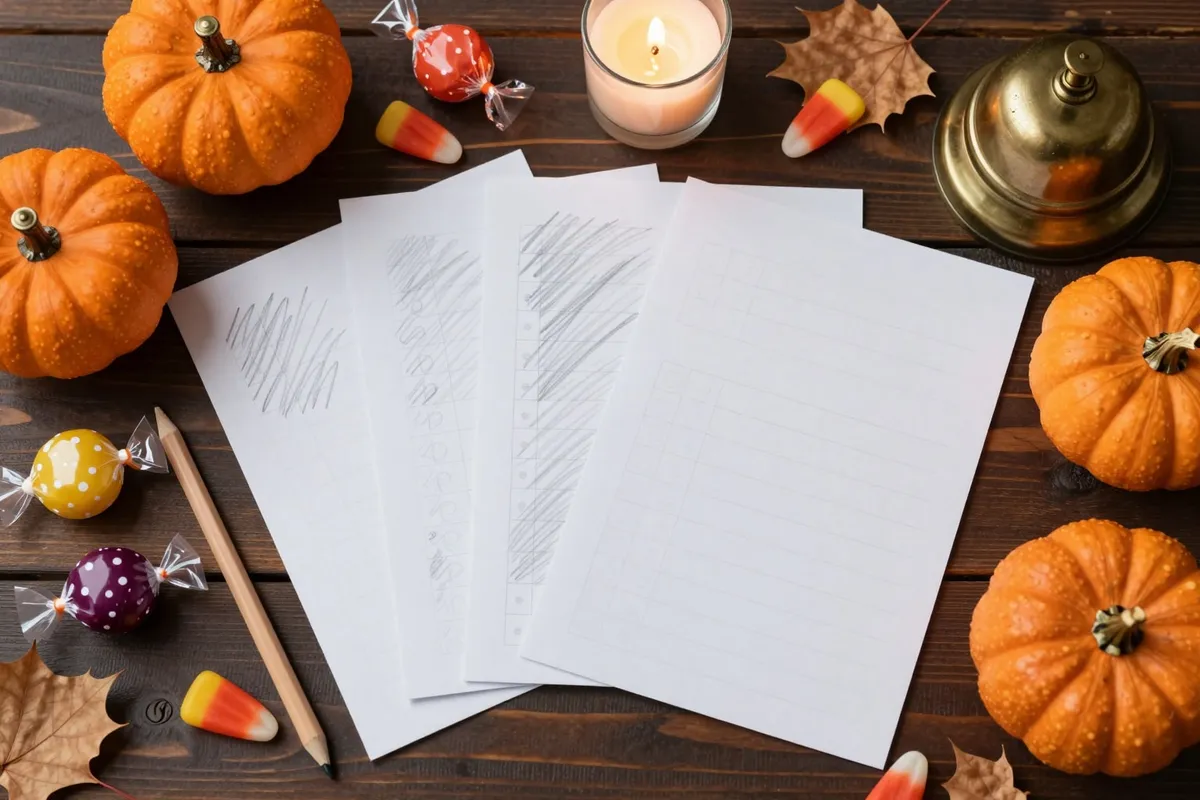
Play in teams of 3-5, so nobody is left alone with a blank sheet and every table starts arguing right away. With 8-12 people, two or three teams are enough, and at the office, make one team per table. The host reads each question twice, gives about 30 seconds and moves on. Teams write their answers on a sheet marked with the round number.
After each round, teams swap sheets and mark each other's answers while the host reads them out. One point per correct answer. Update the scoreboard on a big sheet of paper after every round, because watching someone chase the leader is half the fun. One pub-quiz extra worth borrowing: each team can play a "joker" once, announcing before a round starts that it counts double.
If there's a tie after five rounds, use the tie-breaker. Every team writes down a number, the closest wins, and if that's still a tie, the team that handed in first takes it. For a quiz at home, have ready:
- answer sheets and pens for every team,
- a bell, or a spoon to tap on a glass, for when time is up,
- a big sheet of paper for the scoreboard,
- small prizes, like a bag of candy or a carved pumpkin for the winners.
If the quiz is part of a bigger party, our Halloween party calculator works out the food, drinks, decorations and pumpkins for your guest count.
A quiz makes a great middle of the evening, but not the whole evening. For costumes and warm-up games, see our Halloween party games for adults.
Paper or phones?
Paper works for any group, even 30 people at the office, and needs no setup. The downside is adding up scores and catching answers that were scribbled in after time ran out.
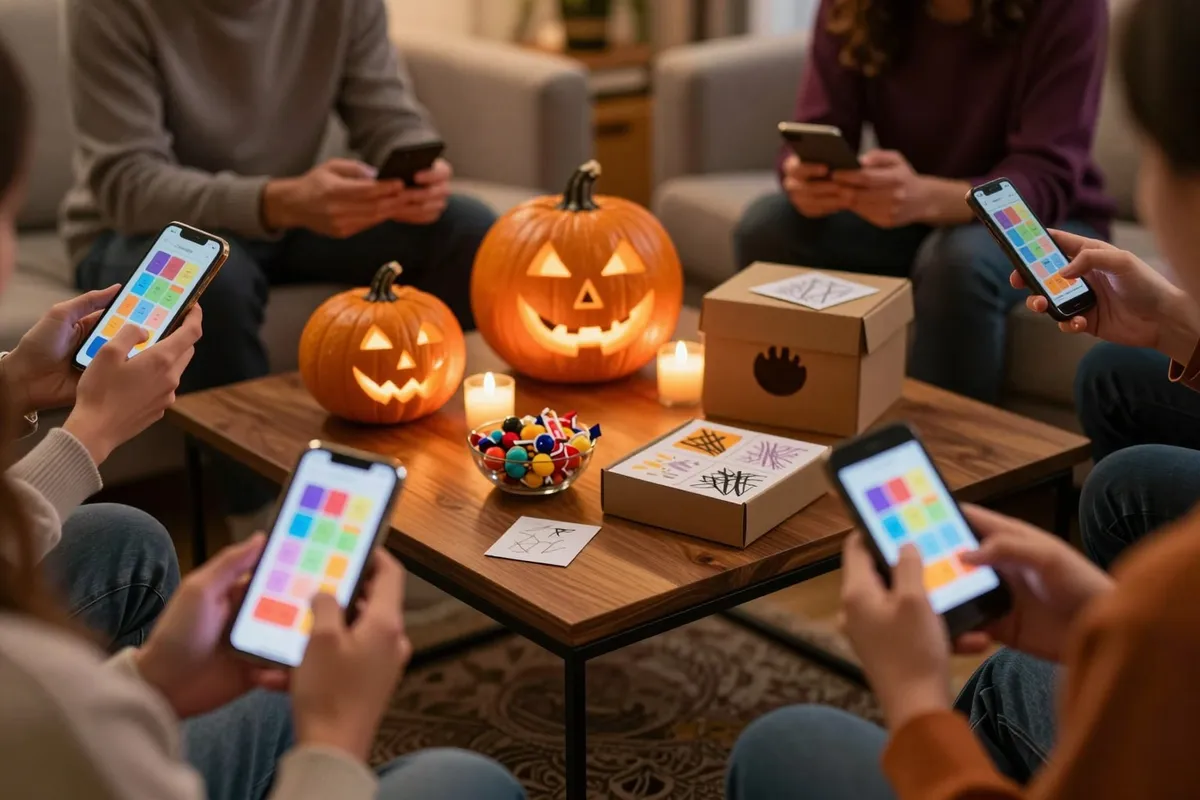
On phones, you can play in Hopsa's free game for 4-12 people, with no account and no app to install. There's no Halloween question pack in the game, but you can type this quiz in yourselves: in the lobby, on the "Add your own questions" card, tap "Add a question", choose "General knowledge quiz", type the question (up to 120 characters) and 2-4 answers, then tap the circle next to the correct one. Number questions like the tie-breaker fit the "How Many?" game, and statements fit "True or False". The other three games (Never Have I Ever, Would You Rather? and "Who of us...?") take your own questions too, but for a scored quiz these three are the ones you need.
Everyone can add up to 15 questions (up to 120 per room). The game picks them first, ahead of the pack questions, and shuffles them in with pack questions; if there are more than fit in one round, the rest come up in the next round of that game. If the host leaves only the "Your questions" pack selected, the game asks nothing but yours. The author of a question doesn't answer it and just watches how the others do, so it's best to split the rounds between 2-3 people. A quiz round has 10 questions with 20 seconds each, the game keeps score, and faster answers earn more points.
If the quiz is part of a bigger office party with a screen in the room, the organizer adds the questions in the host panel, on the "Questions" tab, or imports them from a CSV file. Our guide to office Halloween party ideas covers the rest of the evening, and when the holiday season comes around, our company quiz questions are ready to go.
Topics
Save this guide for later - with a graphic for your ideas board.
Save to PinterestFrequently asked questions
How many questions should Halloween trivia have?
About 30-40, split into 4-5 rounds of 8-10 questions. With scoring, that takes roughly an hour at a party or the office.
How do you make Halloween trivia fun for adults?
Mix easy and hard questions in every round, add a horror movie round and play in teams of 3-5. A number question makes the best tie-breaker, because the closest answer wins.
Can you play Halloween trivia on phones?
Yes. In Hopsa's free game for 4-12 people, every player can add up to 15 of their own trivia questions in the lobby, and the game keeps score. There's no Halloween pack, so you type in the questions from this list.
Did the ancient Celts carve pumpkins?
No. Before pumpkins, people in Ireland and Scotland carved turnips. Pumpkins took over later in North America, where immigrants brought the custom.